
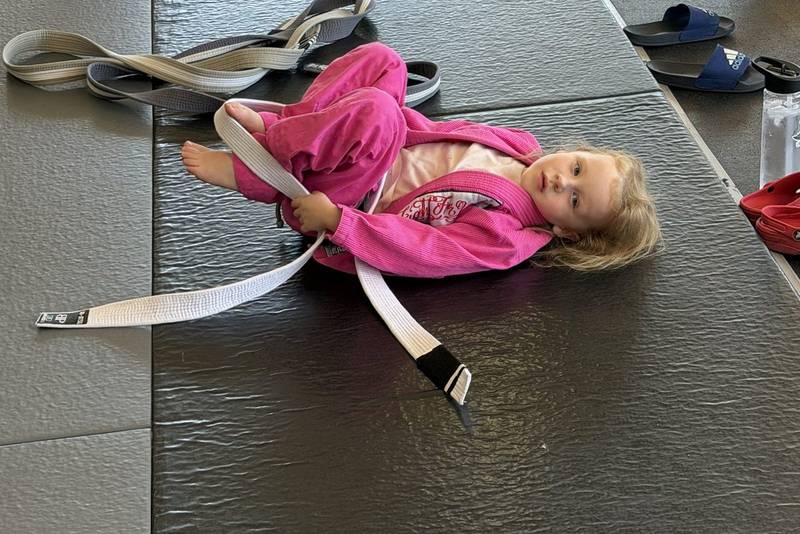
Brazilian Jiu Jitsu is famous for having the slowest belt system in martial arts. That is not marketing, it is the actual design, and it is one of the reasons a BJJ black belt means what it means.
The adult belts
For adults aged sixteen and up, the order is:
- White, everyone starts here.
- Blue, you have a working game and can defend yourself competently.
- Purple, a genuinely dangerous grappler with a developed style.
- Brown, refinement, and usually a real teaching role.
- Black, expert. Not the end, and holders will tell you that unprompted.
Beyond black there are degrees, then coral belts (black and red) at seventh and eighth degree, and red at ninth and tenth, which requires decades and is exceptionally rare.
Stripes
Each belt carries up to four stripes, small marks of progress between belts. They exist because the gap between belts is long enough that people need visible evidence they are moving. Do not overthink them, and do not chase them.
Kids belts
Children under sixteen use a different, more granular system: white, grey, yellow, orange and green, most with white, solid and black variants, plus stripes. It is deliberately finer grained because a child needs progression markers far more often than an adult does to stay motivated over years.
A child cannot receive an adult blue belt before sixteen no matter how good they are. Kids belts convert to adult ranks at that point, generally starting at blue for the most advanced kids.
Realistic timelines
Assuming consistent training of two to four sessions a week:
- White to blue: roughly one to two years.
- Blue to purple: roughly two years.
- Purple to brown: roughly one and a half to two years.
- Brown to black: roughly one to two years.
Which puts a realistic black belt somewhere around eight to twelve years of consistent training. Some are faster, many are slower, and life interrupts nearly everyone. The commonly cited figure is that a very small percentage of people who start Jiu Jitsu ever reach black belt, and the reason is almost never talent. It is attrition.
What actually earns a promotion
Different from what beginners assume. It is not a test you pass on a given day, and at most academies it is not primarily about winning competitions either. Instructors are watching for:
- Consistency. Showing up, for years. This is the biggest single factor.
- Technical understanding across positions rather than one favourite move.
- Defense. Blue belt in particular is heavily about being able to survive and escape.
- How you train with others. Whether you are safe with beginners, whether you control your intensity, whether people want to be your partner.
- Character. A belt is a statement the instructor is making about you in public.
The advice everyone gives and nobody takes
Do not train for the belt. The people who chase promotions are consistently the most frustrated people in the room, because the timeline is long enough that impatience is corrosive. The people who train because they enjoy the training get promoted eventually and enjoy the intervening years.
The real measure of progress is not the colour around your waist. It is that the thing that destroyed you six months ago is now merely annoying.