
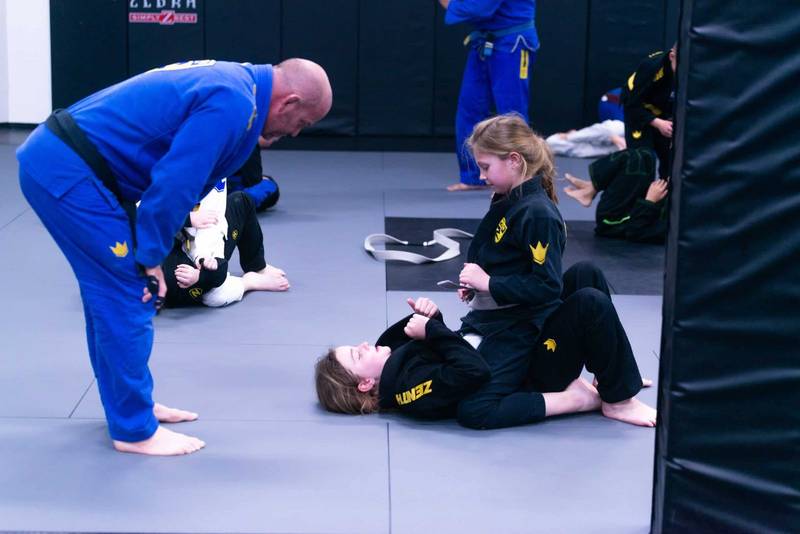
Parents ask three questions, in this order: is it safe, will it make my child aggressive, and will it actually help. Here are the real answers.
Is it safe?
Brazilian Jiu Jitsu is one of the safer martial arts a child can do, and the reason is structural rather than cultural: there is no striking. No punches, no kicks, no head contact. The entire art is grappling, based on leverage and control, which removes the single largest injury category in martial arts training.
In a well run kids program, children are also matched by age and size, submissions are taught with control and released the moment a partner taps, and every minute of live training is supervised. Injuries in a good kids Jiu Jitsu room look like mat burn, jammed fingers and sore muscles. They do not look like concussions.
The safety of any given gym still depends on the instructor. Watch a class before you enroll and look for two things specifically: are the kids being matched sensibly by size, and is the instructor actually watching the live training or standing at the side on his phone.
Will it make my child aggressive?
You are going to get two answers here, ours and the research's, because they do not currently agree and you deserve both.
What we think. It does the opposite, and we are not going to soften that into a maybe. We have watched it for years. Aggression in kids is usually a symptom of feeling unsafe or needing to prove something, and a child who genuinely knows they can handle themselves has far less need to demonstrate it. There is also no offensive striking to rehearse: a child who trains Jiu Jitsu for two years has practiced controlling people, not hitting them, and there is nothing in that toolkit that translates into hurting a classmate on a playground. The culture pushes the same way, because mat etiquette starts with respecting your instructor and your training partners and checking your ego at the door. The most common thing parents tell us after six months is that their kid got calmer, not more confrontational.
What the research says. It does not show that. A 2026 systematic review pooled the longitudinal studies on martial arts and aggression in children and adolescents and found no consistent directional effect. Results varied across disciplines, program structures and settings, and the authors were explicit that martial arts should not be read as having a uniform calming effect on young people.
What that gap does and does not mean. It is an absence of consistent evidence, not evidence that nothing happens. That is a genuinely thin base to conclude anything from in either direction, which is the case for taking what we see seriously. It is also not permission to ignore the finding. Our room is not a study: we watch the kids who stayed, we measure nothing, and we have an obvious interest in the answer coming out our way. So we will tell you plainly that we believe it and that the best available research does not currently back us. Both of those are true, and you are better served holding both than being handed a confident version of either.
One thing we and the review agree on: the room and the coaching matter more than the label on the door. That is the part worth acting on. Go and watch a class.
What it actually gives them
Confidence that is earned rather than told. You cannot talk a child into believing they are capable. Jiu Jitsu gives them evidence: they got out of a bad position, they solved a problem with a bigger kid, they did something in week ten they could not do in week one.
Anti bullying skills that do not escalate. This is the real self defense argument for children. A child who can control a situation without throwing a punch has an option that does not end with both kids suspended. Jiu Jitsu teaches subduing an opponent safely rather than winning a fight.
Discipline and focus. Structured class, a curriculum, belt and stripe progression that rewards showing up consistently rather than natural talent. For kids who struggle to sit still, the fact that the discipline is physical rather than seated is often the difference.
Comfort with struggle. This is the underrated one. Jiu Jitsu involves being stuck, losing, and working through it, constantly and by design. A child who learns that being uncomfortable is survivable rather than catastrophic carries that everywhere.
A place for the kid who does not fit team sports. It is individual, so the quiet child cannot disappear at the back and the small child is not outmatched by size. Leverage and technique beat size and strength, which is the whole premise.
What age should they start?
Programs vary on the starting age; ours takes children from four. Realistically:
- 4 to 5: coordination, listening, following instruction and being comfortable moving on a mat. Treat technical progress as a bonus.
- 6 to 9: real technique starts landing. Positions, escapes, controlled live training. This is the sweet spot for starting.
- 10 to 12: old enough for genuine problem solving and, if they want it, competition.
Later is fine. Plenty of people start as teenagers or adults and do very well. If yours is already past twelve the room they walk into is a different one, because teenagers train with the adults rather than in the kids class, and we wrote about that separately in martial arts for teens. There is no window that closes.
How to tell whether it is right for your child
Take a trial and watch. Not one class, ideally, because kids often need two or three visits before they stop being shy and start engaging. Look at whether your child is being included, whether the instructor knows their name by the second session, and whether they want to go back.
The last one is the real test. A child who asks to go back has told you everything you need to know.