
Greg walks through the same thing in under two minutes:
Almost nobody's first Jiu Jitsu class is bad. Almost everybody's anticipation of it is. The anxiety is nearly always about the unknown rather than the training, so here is the unknown, removed.
Before you go
Wear: board shorts or workout shorts and an athletic shirt with no zippers, buttons, or pockets. Zippers and buttons tear gis and cut people, which is the only reason for the rule. You do not need a gi to try.
Bring: a water bottle, sandals, and trimmed fingernails and toenails. The nails are not a politeness note, they are the main way beginners accidentally scratch training partners.
Arrive: ten to fifteen minutes early. You will meet the instructor, sign a waiver, and get shown where to put your things without walking in during the warm up.
Stepping onto the mat
Shoes come off before the mat, always, and sandals are what get you from the door to the edge of it. Anything that touches the bathroom floor does not touch the mat. This is the single most enforced rule in every academy on earth and the reason for it is skin infection, not ceremony.
The warm up
Expect fifteen minutes or so of mobility movements, a light jog, core exercises and stretching. It is designed to get you loose and warm, not to break you. If something is beyond you, scale it or sit it out. No instructor worth training under will care, and every one of them would rather you sat out than injured yourself in the first twenty minutes.
Technique
The instructor demonstrates the technique for the night, usually breaking it into a few steps and showing it from several angles. Then you pair up and drill it, taking turns, while he moves around the room correcting people.
You will not get it. That is the expected outcome and not a sign of anything. Jiu Jitsu positions involve your whole body doing several unfamiliar things simultaneously, and the first fifty repetitions of anything feel wrong. Your only job on night one is to move in roughly the right direction and let your partner do the same. Copying the shape badly is how everyone starts.
Live training, or rolling
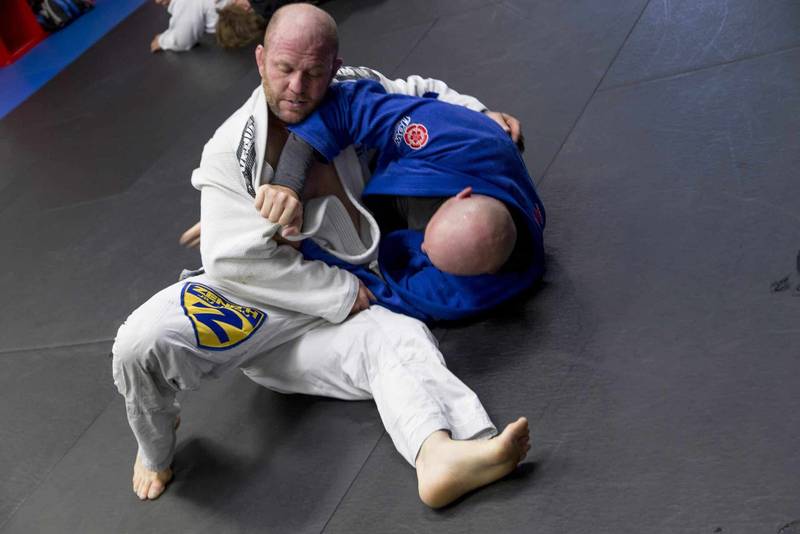
The last stretch of class is live training: applying technique against a partner who is resisting. This is the part beginners dread and it is almost never what they imagine.
As a new person you will be paired with experienced training partners, and their job in that round is not to win. A good upper belt will control the pace, let you work, and stop when something is going wrong. You are not expected to know what you are doing. You are expected to move, tap early, and not do anything wild.
Tapping is how you say stop: two clear taps on your partner or the mat, or say "tap" out loud. It is not losing, it is the mechanism that makes it possible to practice dangerous techniques safely for decades. Tap early and tap often. The people who get hurt in Jiu Jitsu are overwhelmingly the ones who would not tap.
You can also sit out a round. Say so. Nobody thinks anything of it.
How you will feel afterward
Wrecked, honestly, and in muscles you did not know were load bearing. Grip strength and neck are the classic first week complaints. You may have mat burn. You will probably be worse at everything than you expected and slightly exhilarated anyway.
You will also very likely have had a genuinely good time, because the thing nobody tells you about Jiu Jitsu is that the room is usually the friendliest in any gym you have been in. Everyone there was catastrophically bad at this once, most of them recently, and the culture reflects that.
The etiquette, in short
- Keep your uniform clean, and yourself clean. Wash your gi after every session.
- No shoes on the mats, sandals off the mats.
- Trim your nails.
- Respect your instructor and your training partners.
- Arrive on time. If you are late, wait at the edge of the mat for permission to join.
- Check your ego at the door. This is the actual rule, not a slogan.
- Avoid excessive aggression. Control beats intensity, especially with beginners.
- Tap early. Release a submission the instant your partner taps.
Come back
One class is not enough to judge Jiu Jitsu, which is why our trial is two free classes rather than one. Class one is sensory overload. By the second you are recognizing positions instead of just surviving them, which is when you can decide honestly whether this is for you.