
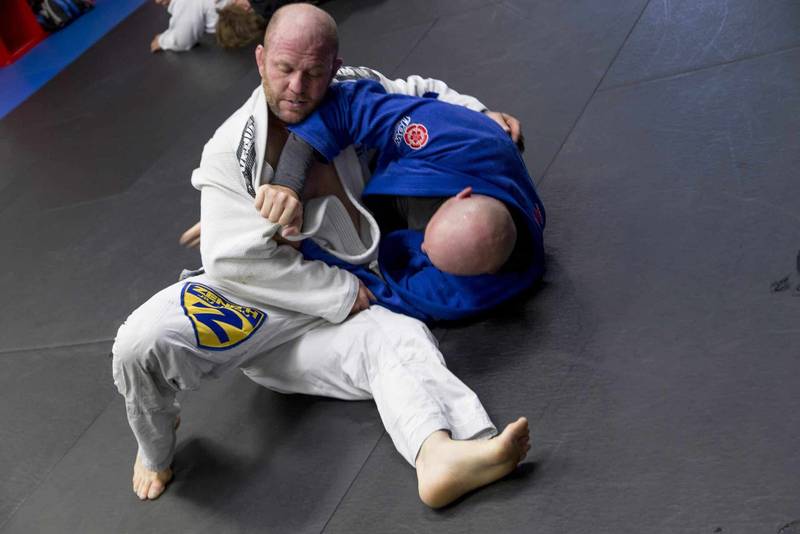
Most people who want to train Jiu Jitsu spend years not doing it. The reasons are always some version of the same three, so let us take them in order.
"I'm too old"
People start in their thirties, forties, fifties and beyond, routinely. Jiu Jitsu is unusually accommodating to this because it rewards technique, timing and patience over explosive athleticism. An older beginner who is calm, listens, and does not try to muscle everything frequently progresses faster than a young athlete who does.
What changes with age is recovery, not capability. You train two or three times a week instead of five, you warm up properly, you tap early and often, and you skip the rounds where somebody has something to prove. That is not a compromised version of Jiu Jitsu. It is how most adults over thirty five train, forever.
"I'm too out of shape"
This is the one that keeps the most people out, and it is entirely backwards. Fitness is what training gives you, not a prerequisite for it.
The warm up is scalable. Drilling is at your own pace. You control your own intensity in live training and you can sit out any round without anyone caring. What you cannot do is get Jiu Jitsu fit at a commercial gym first, because the conditioning is completely specific and nothing else replicates it.
Everybody in the room was catastrophically unfit for this at some point. Most of them recently.
"I'll be the worst person there"
You will be, for a while, and here is the thing nobody warns you about: it does not matter even slightly, because every single person on that mat was the worst person there once and most of them remember it clearly.
Jiu Jitsu has an unusually good beginner culture for exactly this reason. Upper belts are generally not trying to beat you, they are trying to help you, and a good one in a round with a white belt is coaching rather than competing. The intimidation is real and it is almost entirely dissolved by walking through the door once.
What the first six months actually feel like
Weeks 1 to 4. Total sensory overload. You will not remember technique names, you will forget the move you drilled forty minutes ago, and you will get submitted constantly. You will be sore in your grip, your neck and your hips. This is the hardest stretch and it is where most quitting happens. Push through it.
Months 2 to 3. Something clicks. You start recognizing positions rather than experiencing undifferentiated chaos. You survive longer. You begin to understand what happened to you rather than just that something did.
Months 4 to 6. You have a couple of things that work. You escape positions that used to be terminal. You may tap another beginner, which feels disproportionately good. You start to see the shape of the thing.
Blue belt, typically somewhere in year one or two, is when most people realize they are actually a grappler rather than someone attending a class.
How to survive the first six months
- Go twice a week, minimum. Once a week means relearning the same thing forever. Two is the threshold where progress becomes visible.
- Tap early and often. Ego injuries end more Jiu Jitsu careers than anything else. Tapping costs nothing.
- Focus on defense and escapes first. Survival is the foundation. Offense comes later and comes easily once you stop dying in bad positions.
- Pick one thing per session. Do not try to remember everything. Take one detail home.
- Breathe. New people hold their breath and gas out in ninety seconds. Most of your early exhaustion is tension, not conditioning.
- Talk to people. The social connection is what gets you back on the mat on the nights you do not feel like it, and it is genuinely half the reason people stay for decades.
The only thing that matters
Consistency, by an enormous margin. Not talent, not athleticism, not what age you started. The person who trains twice a week for three years will be far beyond the person who trains five times a week for four months and stops.
Go take a trial. The first step is the entire difficulty.