
Most of what you find searching this is a guide about children with the word "teen" pasted over it. The advice stops around fourteen, the examples are eight-year-olds, and the class being described is a games-based kids program your fifteen-year-old would walk out of.
A teenager is a different problem. They are old enough that most gyms put them in the adult class, which is where the interesting questions start, and self-conscious in a way a nine-year-old is not. They may not want to be there at all. And the evidence for what martial arts does to a teenager is thinner, and less flattering, than the pages selling it suggest.
Three questions decide it. Is this a good idea for your teenager at all, which discipline fits the kid you actually have, and is the room you are looking at safe for a fourteen-year-old. Parts of what follows argue against booking a class here. Those parts go in anyway.
One note on how it is written. In places we tell you what we believe after years of teaching teenagers, and in places we tell you what the published research shows. Where the two diverge you get both, labeled. An opinion held by people who do this every weeknight is worth having. It is not worth dressing up as a study.
Is martial arts a good idea for your teenager?
Some of what parents want confirmed can be confirmed. Most of it cannot.
What holds up. The CDC's physical activity guidance for ages 6 through 17 is 60 minutes or more of moderate-to-vigorous activity every day, plus muscle-strengthening and bone-strengthening work at least three days a week each. A 90-minute class four or five evenings a week does a lot of that work. It is arithmetic, not a health outcome, and it matters because the teen years are when organized sport falls away. The Aspen Institute's Project Play reported in its 2025 participation review that regular sports participation for ages 6 to 12 rose for a third straight year while participation for ages 13 to 17 dropped 3% in 2024. Martial arts do not fix that trend. They are one of the few options a teenager can start at fifteen with no background, no tryout and nobody to cut them.
What the research does not support. Confidence, discipline, focus, better grades, lower anxiety. Those carry most of the emotional weight in what is written about martial arts for young people, and the research under them is thin. If a gym tells you a study proves its program builds confidence, ask to see it. It will usually be a small trial in a different age group, a different discipline, or nothing at all.
What we believe anyway, and it is a belief. We think training changes teenagers, and we will say so plainly even though nobody has run the trial that would prove it. We have watched fourteen-year-olds walk in unable to hold eye contact with an adult and, a year later, introduce themselves to a stranger on the mat without being prompted. We have watched teenagers who quit everything keep turning up to something once it stopped being about being naturally good at it. That is what the room looks like to us, and it is not evidence: we see the teenagers who stayed, we have no control group, and we cannot separate what the training did from what growing up was going to do anyway.
Will it make my teenager aggressive, or calmer?
This is the objection nearly every parent raises. It is also the place where our answer and the research's answer are furthest apart, so you are getting both in full.
Our view. Training makes teenagers less aggressive, not more. We believe that, we have believed it for years, and we have watched it happen often enough that we are not going to soften it into a maybe. The mechanism we think we are seeing is simple. A teenager with a short fuse usually has something to prove. On the mat that gets tested honestly, every week, against people who are better than them and who are not interested in humiliating them. Somewhere in the first year most of them stop needing to prove it. The kid who used to escalate in a hallway has already found out what a real physical disagreement feels like, and it turns out to be far less interesting than he thought.
What the research says. It does not show that. A 2026 systematic review in Frontiers in Public Health found that the evidence does not indicate a consistent directional effect of martial arts on aggressive behavior in children and adolescents. It pooled the longitudinal studies on the question, eleven of them, only two randomized, and found that results varied substantially across disciplines, program structures and settings. The authors state plainly that martial arts training should not be read as having a uniform aggression-reducing effect on young people, and that any value it has appears conditional on the teaching goals, the coaching and the training context.
An absence of consistent evidence is not evidence that nothing happens. Eleven studies, two of them randomized, across disciplines as different as tai chi and kickboxing, is a thin base to conclude anything from in either direction. That is the case for taking our experience seriously.
It is also not a licence to ignore the finding. Our room is not a study. We watch the teenagers who stayed, we do not measure anything, and we have an obvious interest in the answer coming out our way. Those are exactly the weaknesses a systematic review exists to correct for. So we hold our view and we are telling you the best available research does not currently back it. Both of those sentences are true at once, and we would rather you had them both than a confident version of either.
Practically:
- If you are afraid martial arts will make your teenager more violent, the research does not support that fear, and it is not what we see either. On this one, we agree.
- The review and our experience land in the same place on one point: the room and the coaching matter more than the label on the door. That is the most useful thing on this page, because it tells you what to go and look at.
A second argument points the same way, and it is reasoning rather than evidence. In a discipline with no striking, meaning no punches, kicks, knees or elbows, there is nothing offensive for a teenager to rehearse. Two years of Jiu Jitsu is two years of practicing how to control a person, not how to hit one. We find that persuasive. It is still an argument about what the training contains, not a tested outcome.
One more finding, this one on bullying. A 2026 umbrella review in BMC Medicine looked across 30 meta-analyses of bullying-prevention approaches and found that martial arts showed the largest observed point estimate within one of its five intervention categories. That sounds stronger than it is: a point estimate inside one category of a review whose own conclusion is hedged, and an umbrella review inherits the quality of what it summarizes. There is a signal. It is not proof that martial arts stop bullying.
Our view is narrower than the headline anyone would want. We do not think training stops a bully. We think it changes the kid who is being targeted, in how they stand, how they answer, and how quickly they stop looking like an easy afternoon. That is a description of the teenagers in front of us. The umbrella review did not measure it.
Which discipline, and how to actually decide
The style taxonomy is the least useful way to choose. What differs between rooms, in ways that matter for a fifteen-year-old, is how much contact there is, when it starts, and who decides. Two words for the table: striking means hitting, so punches, kicks, knees and elbows; grappling means controlling someone with your body through takedowns, holds and position, with no hitting at all.
| If your teenager | Look at | What the contact is | The honest catch |
|---|---|---|---|
| Does not want to get hit, or is self-conscious about their body | Brazilian Jiu Jitsu, judo, wrestling | Close physical contact, no strikes to the head or body | The closeness is the thing. A minority of teenagers cannot stand being held down, and you will know inside two classes |
| Wants to hit something | Boxing, kickboxing, Muay Thai, karate, taekwondo | Striking, with head contact depending entirely on the gym's sparring policy | Ask when head contact starts, how it is protected, and who decides intensity. Answers vary between gyms teaching the same art |
| Is small for their age, or has been pushed around | Grappling arts | Leverage and position rather than size and reach | Grappling narrows a size gap, it does not erase one, and it makes nobody untouchable |
| Wants MMA because of what they watch | Mixed martial arts | Striking plus grappling | The American Academy of Pediatrics discourages MMA for young participants. Read the safety section below first |
Two rules carry more weight than the style you land on, and both are our opinion rather than anything published. Let the teenager pick: you are not choosing a lifelong sport, you are choosing the door they will walk back through next Tuesday. And watch a class before you commit, all of it, because how a coach speaks to a beginner who is failing tells you more than any comparison table, this one included.
If your child is twelve or under, the calculus is different and a games-based kids program is usually the right fit. Our kids Jiu Jitsu class runs ages 4 to 12.
What training at thirteen or fourteen actually looks like
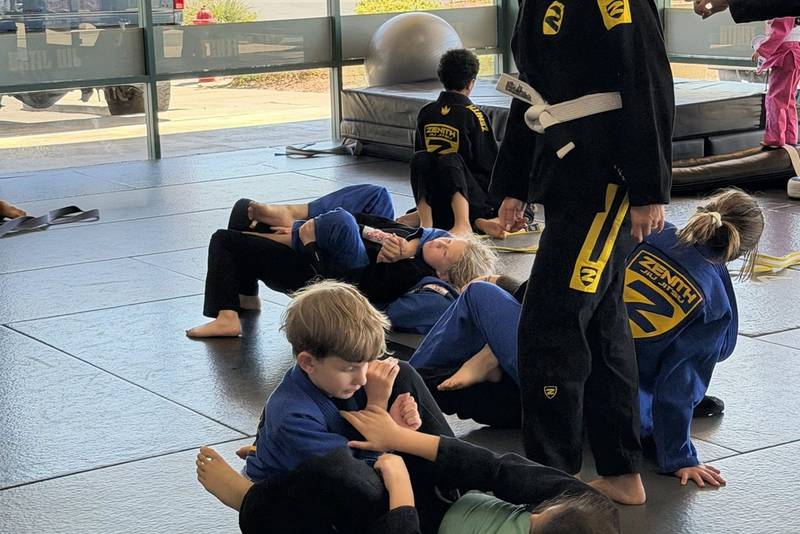
At this academy, teenagers train in the adult Brazilian Jiu Jitsu class, Monday to Friday, 7:00 to 8:30pm. Kids Jiu Jitsu runs to age twelve; from thirteen they come to the adult class, and there is no separate teen class. It is mixed level and takes complete beginners, so a fourteen-year-old who has never done a sport trains next to adults at every stage from first week to black belt. The Jiu Jitsu is gi-based, meaning everyone trains in the heavy cotton uniform, and there is no striking in it.
That arrangement is common across the sport, and it is the part of your decision with the least published guidance behind it.
What we think of that arrangement. It is good for a thirteen-year-old. A teenager in a room of adults gets spoken to like a person with responsibilities. Nobody organizes a game around them, nobody manages their feelings, and the person they are training with is a plumber or a nurse who came straight from work. Most teenagers rise to that faster than they rise to being handled. That is our view after years of doing it this way. It is also the arrangement we sell, with no study behind it, so do not let it stand in for the questions further down. A gym willing to state a strong opinion is a gym you should be willing to check.
The U.S. Center for SafeSport's Minor Athlete Abuse Prevention Policies require that all one-on-one in-program contact between an adult participant and a minor athlete be "observable and interruptible," except in emergencies, and that electronic communication between adults and minor athletes be open and transparent. They bind organizations within the US Olympic and Paralympic Movement: national governing bodies, their local affiliated organizations and affiliated clubs, regardless of formal membership status. Judo, wrestling and taekwondo have USOPC national governing bodies, so their affiliated clubs are covered. Brazilian Jiu Jitsu is not an Olympic sport and has no USOPC national governing body, so an independent BJJ or MMA academy sits outside MAAPP unless it adopts the policies voluntarily, which the Center recommends for any organization whose adults have regular contact with or authority over minor athletes.
That is a statement about scope, not a judgment about any gym, this one included. It does not mean an academy outside the policy is unsafe, or that one inside it is safe. In this corner of youth sport, no external body is doing the checking, so the checking is yours. That is the argument for the question list further down.
The sport itself draws a line somewhere else. The federation that runs most competitive Jiu Jitsu will not let a juvenile competitor move up into the adult division, and the rule is deliberately one-way: older competitors may register down into younger brackets, but a juvenile may not register up. So the sport separates teenagers from adults on the day it matters most, while the same teenager trains with adults in class every week. The federation has taken no position on who trains together in class, and this is not a scandal, but it is a tension worth holding when a gym tells you mixed-age training is nothing to think about.
Safety, including the parts that count against us
The injury evidence, and what it cannot tell you
Nothing published can tell you what your own kid's next twelve months look like. There are no blows to the head in the Jiu Jitsu class here because there is no striking in it, but that is a fact about what the class contains, not a safety ranking.
A 2023 study in the American Journal of Sports Medicine used national emergency department surveillance data from 2004 to 2021 and found mean injury rates of 2.22 per 10,000 children aged 12 to 17 against 1.15 per 10,000 aged 3 to 11. Read the denominator: those are rates per 10,000 children in the population, not per participant and not per training hour. The study did not adjust for how many children in each band train, or how often, so it cannot tell you your fourteen-year-old is twice as likely to get hurt in a session as a nine-year-old. What it establishes is that the 12 to 17 band accounts for a disproportionate share of martial arts injuries reaching an emergency department, and because it counts only injuries bad enough to reach one, it undercounts the sprains and jammed fingers that make up most of the real total.
The same study found that competition, compared with other settings pooled together, carried 2.56 times the risk of head and neck injury and 2.70 times the risk of traumatic brain injury. If your teenager is not competing, the sharpest part of that risk is not in front of them yet.
Two Jiu Jitsu figures get quoted at parents, and they look like they disagree. A 2014 study of eight Jiu Jitsu tournaments in Hawaii recorded 9.2 injuries per 1,000 match exposures, which sounds reassuringly low. A 2019 survey of one club in Ontario found that 91% of participants had been injured in training at some point, two thirds of them needing medical attention and 15% surgery, which sounds alarming. Different denominators, not a contradiction. The first counts injuries per match on competition day. The second is lifetime prevalence among seventy self-reporting adults at one club, mostly sprains and strains to fingers, the upper extremity and the neck, with no age breakdown and no way to convert it into a per-year risk. Neither says anything about a fourteen-year-old. And the 2014 study compared Jiu Jitsu only against judo, taekwondo, wrestling and MMA, not against soccer, football, basketball or gymnastics, and not in children. You will see it cited for that wider comparison. It does not support it.
Where we come down on this, and it is a judgment rather than a finding. Jiu Jitsu is a contact sport, and nobody here is going to call it safe. Train for long enough and something will hurt: fingers, ribs, a neck that complains for a week. We believe the trade is worth making for most teenagers, because the alternative on offer to a fifteen-year-old is usually nothing physical at all, and because learning to be uncomfortable on purpose is one of the few things we are confident this sport teaches. That is a view about what a teenager's time is for, not a risk calculation, and it is reasonable for you to weigh it differently than we do.
What the American Academy of Pediatrics says about what we teach
You have now read several of our opinions, stated firmly. This part belongs to somebody else. Two things, both of which cut against this academy's interest.
The AAP names choking and submission movements among the higher-risk activities in martial arts. Its 2016 clinical report on youth participation and injury risk distinguishes non-contact forms and technique work, which carry a lower relative risk, from contact-based sparring and competitive bouts, which carry a higher one, and states that some of those higher-risk activities include blows to the head and choking or submission movements that may cause concussions or significant head injuries. A submission is a joint lock or a choke that makes an opponent give up by tapping. Brazilian Jiu Jitsu is a submission art. Chokes and joint locks are the core of it, including in the class your thirteen-year-old would join here. We are not going to file that under a footnote.
The AAP's parent guidance page on martial arts, last updated in May 2025, states that MMA should be generally discouraged for young participants. The same page advises focusing on non-contact form and skill development before considering any sparring or contact. This academy runs an MMA class that is striking plus no-gi grappling, on Wednesday from 6:00 to 7:00pm, open to kids and adults, plus a Saturday morning session for adults. Greg Kalteich teaches it with other coaches on the mat.
Those two facts sit next to each other and we are not going to reconcile them for you. The professional body for American pediatricians takes a position against a class we run and sell, and we are not offering a counter-opinion to blunt it. You now know the position, from us, before you booked anything. If it changes your mind about MMA and you look at grappling instead, or at nothing at all, that is a reasonable place to land.
You should not stop worrying about injuries, and we would not ask you to. What helps is finding out how a specific room handles contact, and that takes questions.
The questions to ask any gym, including this one
Ask these out loud, at the gym, of a person, and watch how comfortable the answer is.
On supervision and safeguarding, which matter most if your teenager will be in an adult class:
- Do you follow a written safeguarding policy, MAAPP or an equivalent, and can I read it?
- Are coaches background-checked? Has anyone here done abuse-prevention training?
- Is there any circumstance in which my teenager would be one-on-one with an adult out of sight: before class, after class, in the office, on a private lesson?
- How are teenagers paired for drilling, and who chooses the partner, the coach or the room?
- Do teenagers do live training against adults, and if so which adults, and under what instructions?
- Can I watch, from where, and for the whole class or only part of it?
- How do coaches communicate with under-18 students, and are parents included?
On contact and injury:
- When does a beginner start sparring, meaning training against a partner who is resisting, and how is intensity controlled before then?
- What is your rule on releasing a submission, and what happens to someone who ignores it?
- Who is on the mat when someone gets hurt, and what is the protocol?
- Does anyone here compete, and is competing expected or optional?
On money, before you sign anything:
- What does the monthly fee not include: uniform, protective gear, grading or testing fees, competition entries?
- Is there a contract, how long, and what does cancelling cost?
Ask us those questions too. This page will not answer the safeguarding ones on the academy's behalf: an article written to be found in a search is the wrong place for a parent to learn how their child is supervised. We have given you our opinion on everything else here. This is the one subject where an opinion is worth nothing. Ask in the room, of a person.
Cost and commitment
Any national average you read is close to meaningless for the room down the road from you. If you are in the area, our guide to what BJJ costs in Las Vegas goes through the real range and what drives it. Wherever you are, the number on the website is rarely the number you pay, so ask what it excludes.
The class here runs 7:00 to 8:30pm on weeknights, late enough to be a real conversation about homework and early enough to be survivable. Two evenings a week is the practical floor for a teenager to progress rather than relearn the same thing each visit. That floor is our judgment and not a finding: it comes from watching who progresses and who spends every Tuesday recovering last month's lesson. Check the full schedule against their week before you promise them anything.
If you want to try it
Two free classes, and they cover either program. The first is sensory overload for anybody; by the second a teenager starts recognizing what is happening instead of just surviving it.
Come and watch first if you would rather. Sit through a full session, look at how the coaches handle the newest person in the room, and ask the awkward questions on the list. If the answers are good, book the two free classes. If they are not, ask them somewhere else.