
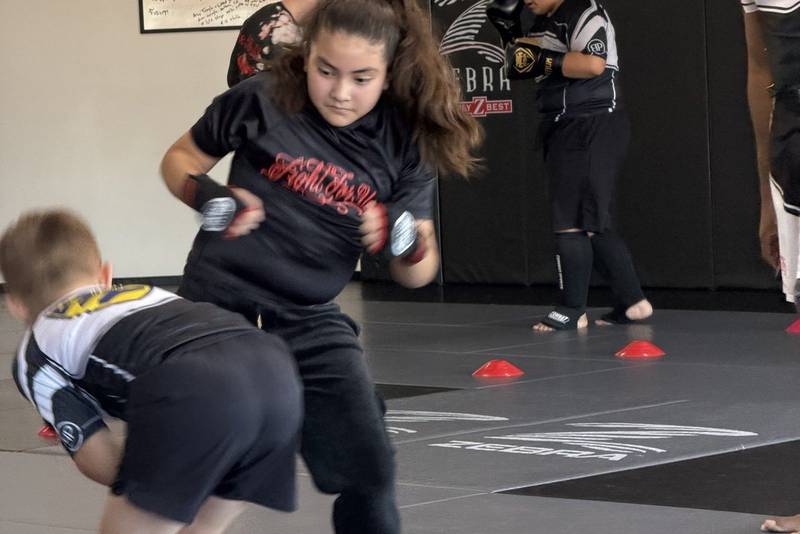
Brazilian Jiu Jitsu is not MMA's rival. It is one of the parts MMA is built from, and grappling of that kind is a standard component of MMA training. So the sport-versus-sport version of this question has no answer.
The version you are actually facing does. It is two classes, on a Tuesday, in a real room. One is grappling in a uniform, where nobody is allowed to hit you. The other is punching and kicking alongside grappling, without the uniform. That is what this page compares: the two as a beginner would train them.
The short answer: start with BJJ
If you are a complete beginner with no combat sports background, start with BJJ. Three reasons.
Nobody hits you. Not on night one, not in month six, not ever. BJJ has no striking in it at all. That removes the thing most beginners are quietly worried about, and it removes it permanently rather than postponing it.
You are learning one thing instead of three. An MMA class asks you to punch, kick, wrestle and grapple. A BJJ class asks you to grapple. When everything is unfamiliar, one unfamiliar thing is easier to get hold of than three.
None of it is wasted if you switch. Because BJJ sits inside MMA, a year of Jiu Jitsu is not something you start over from when you walk into an MMA class. You are adding striking to a base. The reverse is less true.
There is a fourth reason people give: grappling takes longer to learn than striking, so start with the slow one. That is the common view among coaches, ours included. We have not seen it measured, so we are not going to hand it to you as a fact.
Where this is coming from, since it should change how you read it: we teach both. Same building, same head instructor, and the same two free classes cover either one. Our week looks identical whichever you pick.
Who should not follow that default
- You already wrestle, box, or kickbox. You have one piece of MMA in place. Going straight into MMA builds on it instead of parking it.
- You specifically want to fight MMA. Amateur MMA has its own rules, distances and timing. Train the thing you want to do.
- You know you quit repetitive things. BJJ is the same room and the same problem every night for a long time. Some people find that meditative. Some find it unbearable by week five. If you are honestly the second type, the variety in an MMA class is not a compromise, it is the reason you will still be training in March.
- Your schedule decides it for you. Our adult BJJ runs Monday through Friday, 7:00 to 8:30pm. Our MMA runs Wednesday at 6:00pm and Saturday morning at 9:00. If the only slot you can reliably make is Saturday, the debate is over.
That last one sounds trivial. It is the most common real reason people end up in one class rather than the other, and it beats every argument on this page.
What each one actually is
A few terms, defined once.
Grappling is everything you do while holding onto someone: takedowns, control on the ground, escapes. Striking is punching, kicking, knees and elbows. A submission is a joint lock or a choke, and your partner ends it by tapping, a clear tap on you or on the mat. Sparring in Jiu Jitsu is called rolling: live practice against someone who is genuinely resisting.
BJJ here is trained in a gi, the heavy cotton uniform with a belt. The jacket and trousers are part of the game, because you can grip them, and gripping them changes how the whole thing is played. No striking. Position first, then a submission.
MMA here is striking plus no-gi grappling: shorts and a rash guard rather than a uniform, and no cloth to grip. No-gi is not a separate martial art. If you want the longer version of what dropping the uniform does to your grappling, we wrote a separate guide on gi versus no gi.
What your first class actually looks like
People do not really want a definition. They want to know whether a stranger is going to punch them in the face on a Wednesday.
In BJJ, no. You will warm up, learn a technique, drill it badly with a partner, and then roll. New people get paired with experienced ones, whose job in that round is not to win. You will be confused. That is the expected outcome and not a sign of anything. We wrote the full walkthrough of what happens at a first BJJ class, including the etiquette nobody explains to beginners. Our adult BJJ classes are all levels, so the room you walk into on night one is the room the blue belts are in.
In MMA, eventually yes, and not the way you are picturing it. A beginner MMA class is drilling. Stance, footwork, how to throw a jab without falling over, how to take someone down, what to do off your back. Our MMA program is built for people with no experience, taught by Greg Kalteich with assistant coaches, and the coaches match the intensity to whoever is on the mat that night. But the discipline includes being hit, and pretending otherwise would be dishonest.
What you need to bring to a striking class is a phone call, not a guess. Ask before your first one.
Is one of them safer?
Nobody can honestly tell you. That is not evasion, and here is the whole of it.
Injuries in both have been studied. They have not been studied in a way that lets you put the numbers side by side.
| Study | What it measured | Rate reported |
|---|---|---|
| BJJ competition, Hawaii, 8 tournaments 2005–2011 | Injuries recorded at the event | 9.2 per 1,000 match participations |
| BJJ practitioner survey, 881 people, published 2025 | Self-reported recall of past injuries | roughly 5.5 per 1,000 training hours |
| MMA athletes, 112 people, mostly Austria | Self-reported, training and competition hours combined | 1.4 per 1,000 hours |
| Professional MMA competition, systematic review of 43 reports | Injuries in sanctioned bouts | 23.6–54.5 per 100 athlete-exposures |
Look at the bold column. Four studies, four denominators. A match participation is not an hour. An hour is not an athlete-exposure. You cannot line those up and subtract.
Two of those rows need their scope said out loud. The Hawaii number is clean, and it is about competition: 46 injuries across 5,022 match participations at eight tournaments, about 78% of them orthopedic, with the elbow the most common site among those. It describes people competing in BJJ tournaments. It says nothing about your Tuesday class, which is the population you belong to. The 5.5 figure is different in kind. It comes from a retrospective questionnaire, so people were remembering injuries rather than logging them, in a sample that skews male and competition-adjacent. Treat it as an indication, not a measurement.
The other two rows describe other populations again. The MMA training figure comes from 112 athletes, most of them in Austria, reporting 127 injuries across roughly 94,000 hours. In that sample the recreational athletes were injured more often per hour than the competitive ones, though less severely. Most of the competitive athletes' injuries happened in training, not in fights. The systematic review describes professionals fighting in cages under the Unified Rules, and reports concussions at 14.7 to 16.1 per 100 athlete-exposures alongside those injury rates. Its own authors say those studies cannot be cleanly compared to each other, because there is no agreed definition of what counts as an injury.
Now the trap. Taken at face value, the BJJ training figure is higher than the MMA training figure. Do not read that as "BJJ is more dangerous than MMA." One sample is 881 people, the other is 112. They counted injuries differently and recruited differently. The gap between those two numbers is a gap between two methods, not between two sports.
No study we could find compares BJJ and MMA beginner training injury rates using one injury definition, one denominator and one population. The comparison you came here for has not been measured. If someone hands you a confident answer, ask them what they counted.
What you can say without a study is mechanical, and you can check it yourself. BJJ contains no strikes, so it contains no strikes to the head. MMA includes striking, and striking is how head contact happens. That is a difference in the activity, not a measured difference in outcomes. It is the basis for the widely held view that grappling-only training is gentler, and it is why the safety argument for kids is stronger than the safety argument for adults.
One thing you can act on tonight, in either room: tap early. That is coaching advice with no study behind it, and it is still the variable you control most directly.
Which is better for self defense?
There is one strong piece of evidence on this question, and it is not about either of these.
A randomized trial published in the New England Journal of Medicine in 2015 put first-year university women aged 17 to 24 into a specific program: four three-hour sessions of empowerment self-defense training. One-year risk of completed rape was significantly lower in that group, a relative reduction of roughly 46%.
Read the boundary carefully, because it is the point. That trial studied a 12-hour empowerment self-defense curriculum. It did not study BJJ. It did not study MMA. It shows that training of this kind can measurably change what happens to people. It tells you nothing about which of these two classes to walk into. No study we located compares BJJ-trained against MMA-trained people on real-world outcomes.
While we are here: the statistic everyone quotes about most fights ending up on the ground traces back to an analysis of Los Angeles police arrest reports from 1988. Police arrests, not street fights. It is not a reason to pick either of these.
What is defensible is a description of the training. Both classes put you in live practice, every week, against a person who is trying to stop you. BJJ does that from the first week without strikes. MMA does it with strikes in the mix. If self defense is your main reason for training, our honest look at BJJ for self defense goes further into what grappling does and does not prepare you for.
Which one for a kid?
For most children, BJJ, and the reason is structural rather than philosophical. There is no striking, so there is no head contact to train. In both MMA studies above, the head and neck were the most commonly injured region; removing the technique removes the category. Our kids BJJ program runs from age 4 to 12, in the gi.
Our Wednesday MMA class is open to kids as well as adults, and it includes striking. Some parents want that and are clear-eyed about it. Others do not. Both positions are reasonable, but a parent should choose it knowingly rather than discover it in week two. If you are weighing that class for a specific child, ask about it on the phone rather than assuming from the schedule.
Martial arts are marketed to parents as a fix for focus, discipline and behavior, and the evidence is genuinely mixed. A 2004 randomized trial of school-based Tae Kwon Do found improvements in self-regulation and classroom conduct. A 2026 meta-analysis of randomized controlled trials concluded that current evidence does not support significant effects on aggression or prosocial behavior. Neither of those studied BJJ or MMA. Enroll your child because they might enjoy it, not because you were promised a behavioral outcome. Our parents' guide to BJJ for kids covers what to look for when you watch a class.
Can you do both, and in what order?
Yes, and plenty of people do. With MMA on Wednesday evening and Saturday morning and BJJ Monday through Friday, doing both in one week comes down to your calendar.
For a total beginner we would still start you in one. Two new disciplines at once means being bad at two things simultaneously, and the discouragement compounds. Give the first one a couple of months to stop feeling like chaos, then add the second. We have no study for that. It is what we would tell you at the door.
One asymmetry worth knowing before you commit. BJJ has a formal belt system, an international federation, and minimum times you must hold each rank before promotion. MMA has no universal ranking system at all. Neither fact should decide anything by itself, but people are often surprised by it, and if visible progression is what keeps you turning up, that is a real difference.
What it costs, in money and hours
We do not have a national average price worth printing, and costs vary enormously by city and by gym model. If you are in this market, what BJJ classes cost in Las Vegas has the real local picture.
On time: a class here runs from an hour to ninety minutes depending on the program. Two sessions a week is the realistic floor for getting better rather than just attending, and three is noticeably better than two. That is a rule of thumb from the mat, not a study.
So which one are you starting?
If you are a beginner with no background and no strong preference, book a BJJ class. If you already grapple or strike, or you specifically want to fight, book MMA. If your only free night decides it, let it.
If you cannot tell, stop theorizing and go find out. Your first two classes are free and they cover either program. One class is not enough to judge either discipline. Two is roughly where you stop just surviving and start recognizing what is happening to you, which is when you can decide honestly.
Both programs run at one address in northwest Las Vegas, under the same head instructor. Pick the one you will still be doing in a year.